Guedra encompasses various aspects of a traditional dance specific to Southern Morocco, Mauritania, and Algeria.
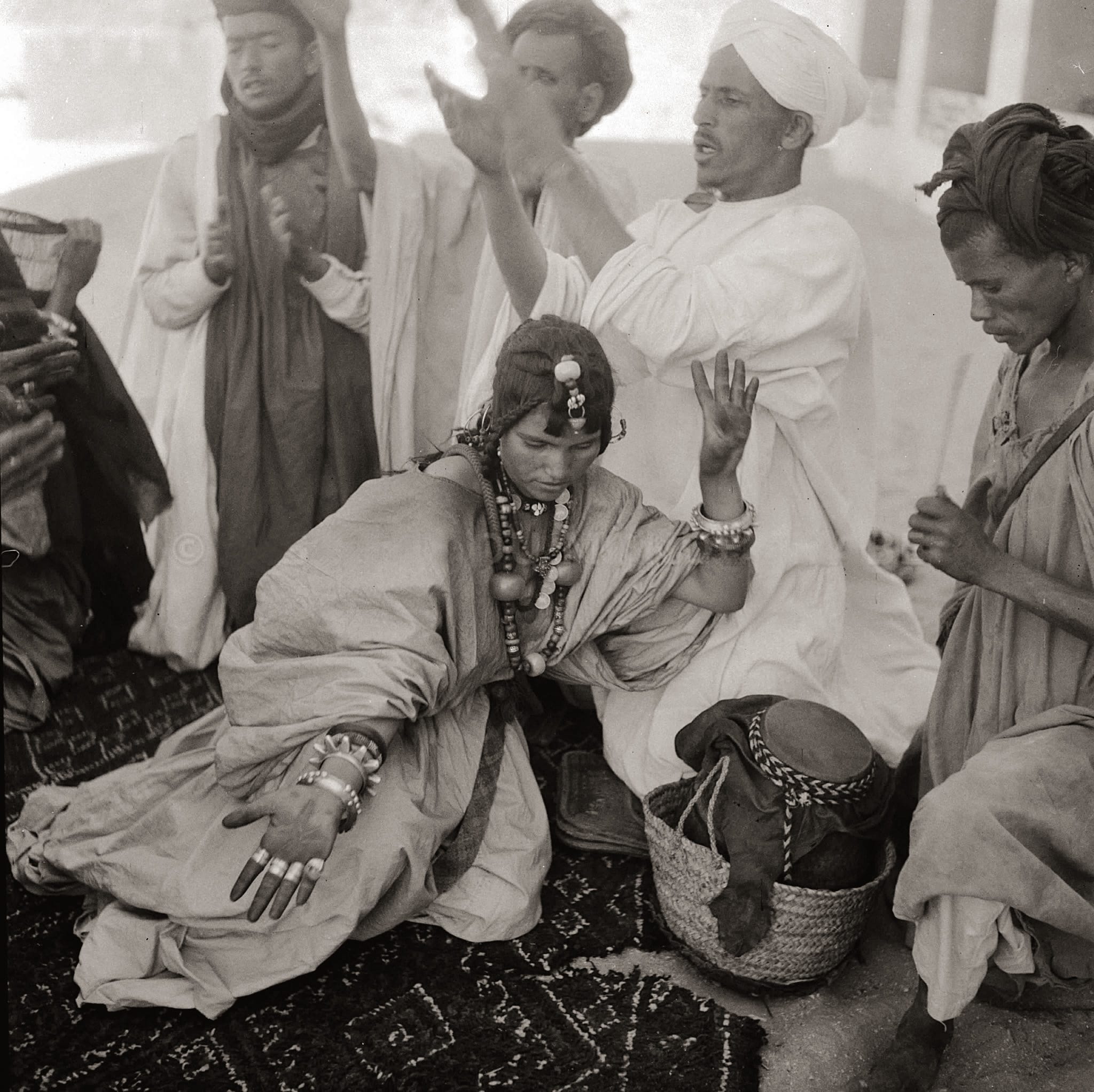
An Ait Oumribet dancer performs the Guedra in the center of a circle of men. She approaches the guedra, a pottery vessel nestled in a basket whose opening is covered with a piece of leather. The drummer strikes the guedra with sticks, while the men clap their hands. The dancer is adorned with jewelry: enormous spiked bracelets and necklaces of amber beads.
Date photographed: 1934
Location: Morocco, El Ayoun du Draa
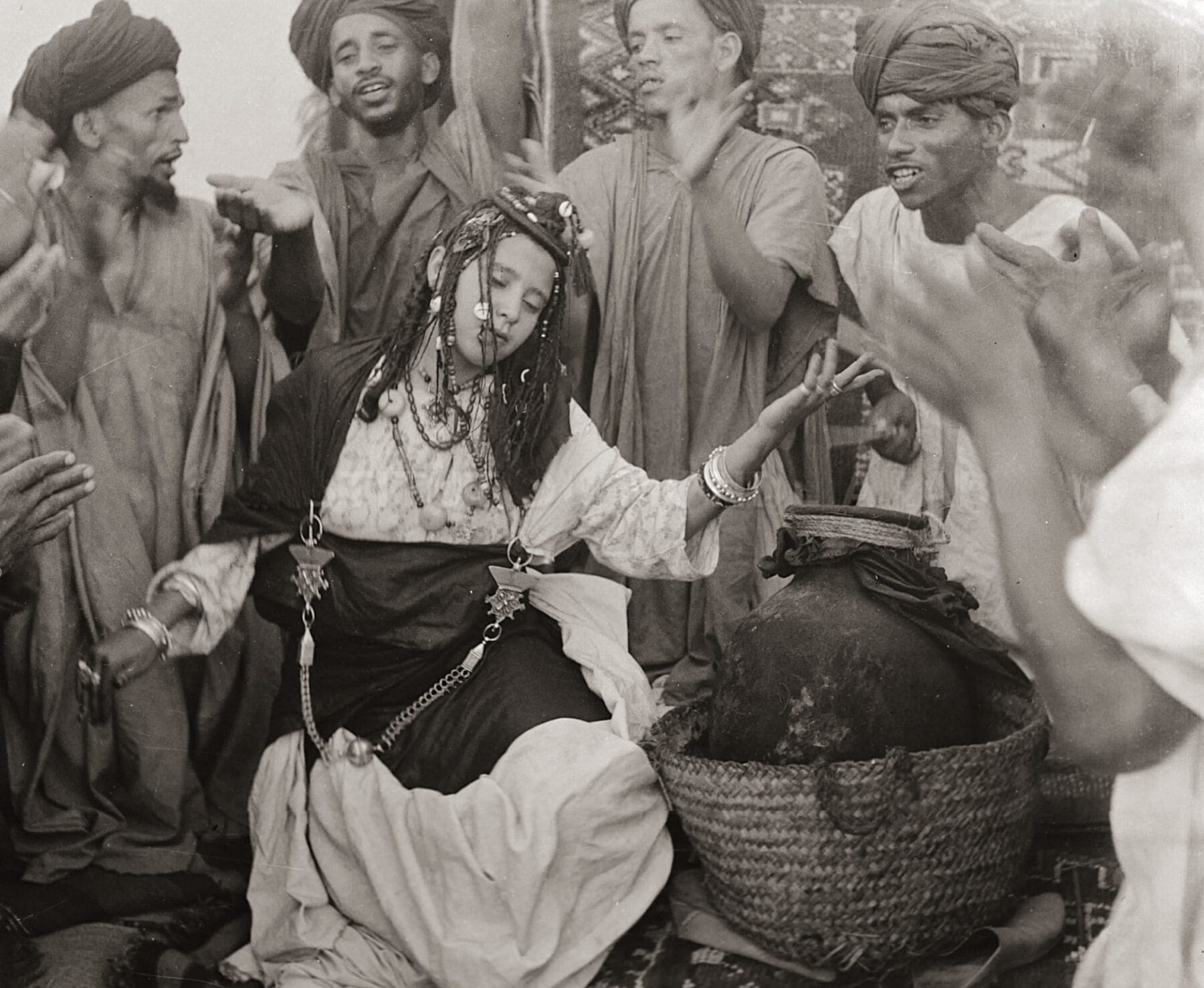
An Ait Oussa dancer performs the Guedra in the middle of a close circle of men. She approaches the guedra, a pottery vessel nestled in a basket whose opening is covered with a piece of leather. The men clap their hands. The dancer is adorned with her jewelry.
Date photographed: 1934
Location: Morocco, Goulimine
The term “Guedra” primarily refers to a cooking pot. When this pot is covered with a stretched leather skin to create a drum, the drum itself is also called Guedra. The rhythmic beat produced by the drummer, which mimics a heartbeat, is known as Guedra as well. The dance movements performed in response to this beat, with dancers remaining on their knees throughout, are referred to as Guedra, and the dancer is also called Guedra.
During the performance, dancers are often draped in fine fabric veils but are heavily adorned beneath with henna, jewelry, and elaborate headpieces. The dance is typically performed in nomadic tents, with women remaining on their knees for much of the performance.
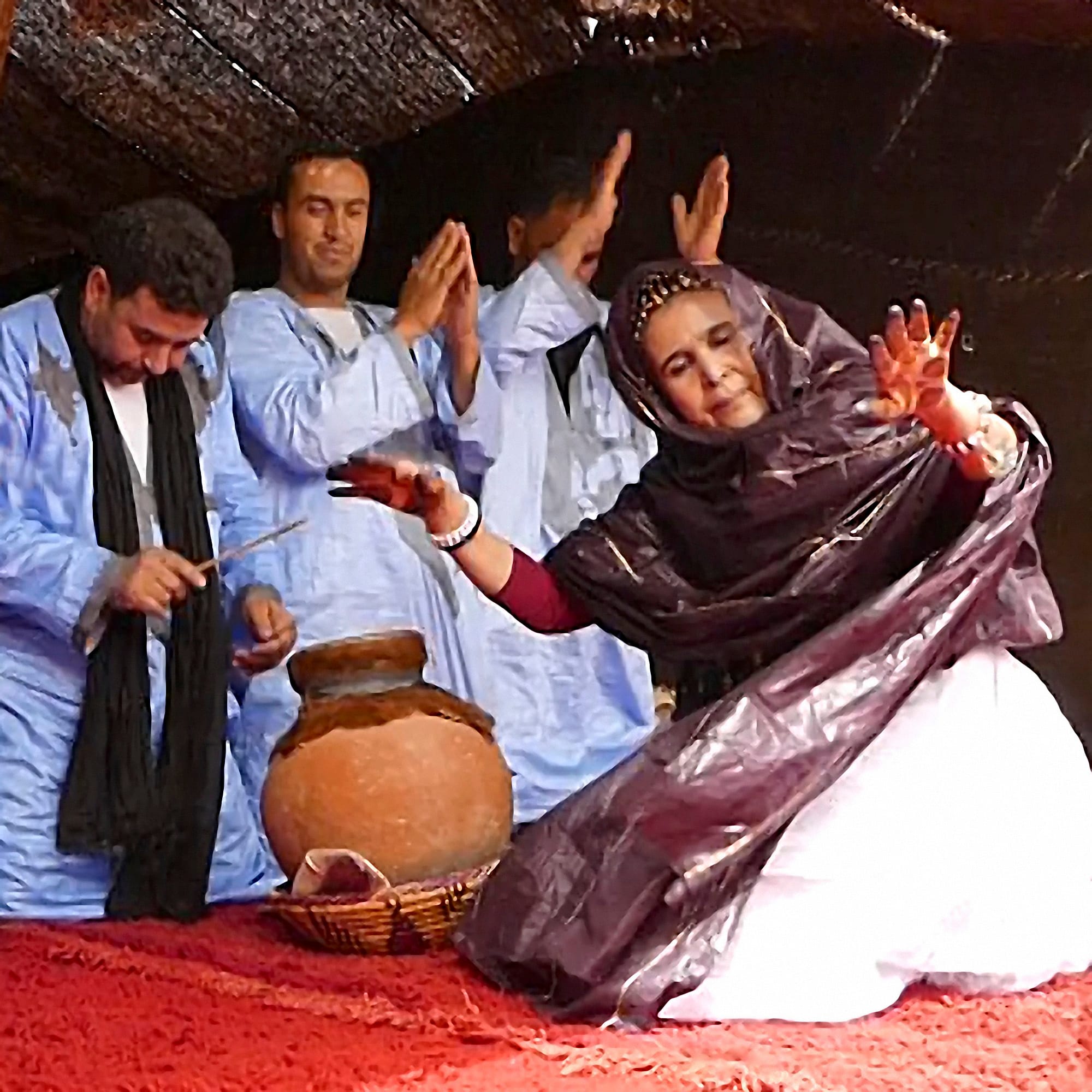
Tan-Tan, 2018, photo Willem de Rooij
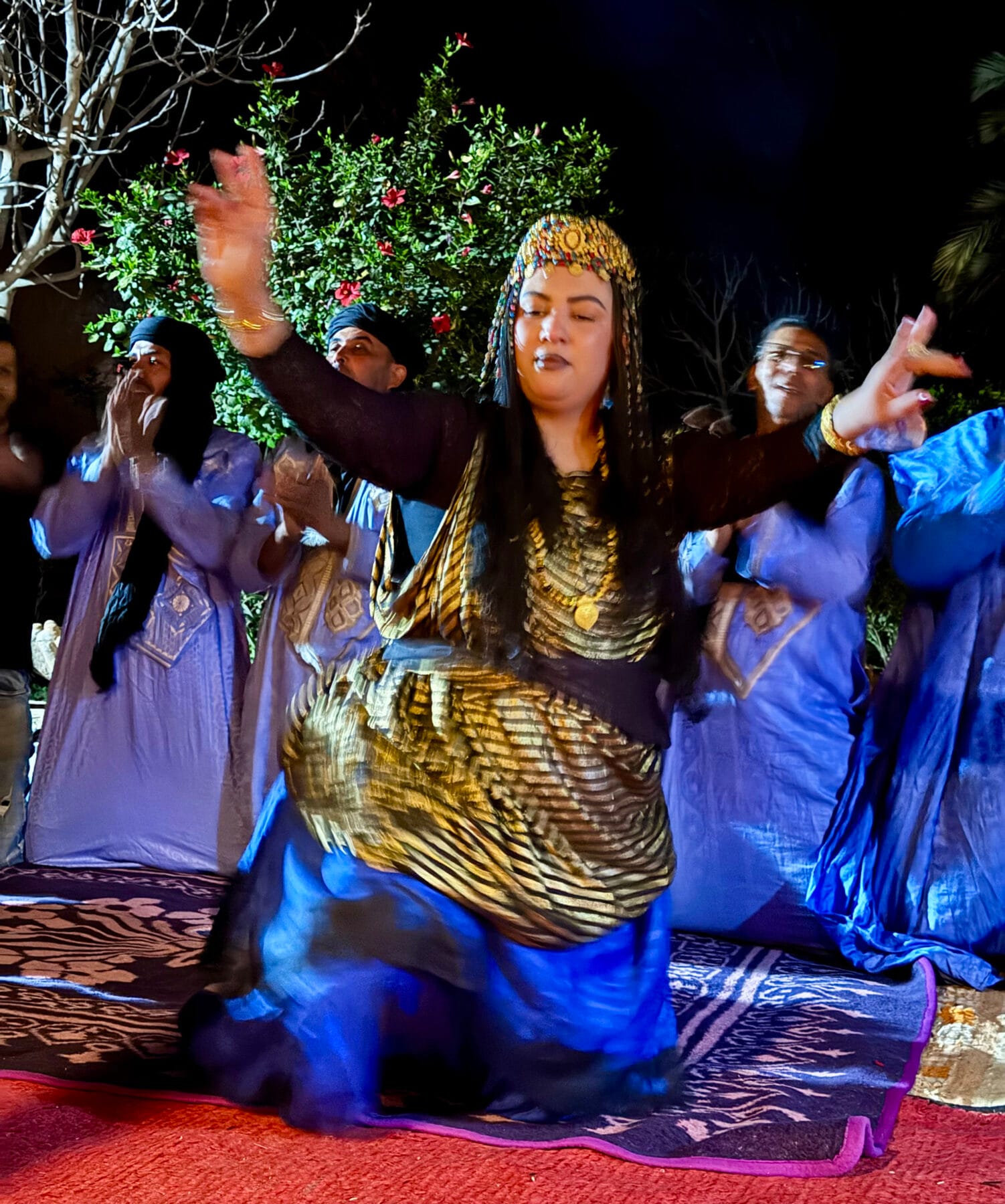
Tighmert, 2025, photo Willem de Rooij
In 1959, Paul Bowles made audio recordings of the Guedra in Guelmim. These recordings are housed in the Archives of the Library of Congress.
https://www.archnet.org/collections/928
Below you can read the notes Paul Bowles made during the 1959 recording of the Guedra.
7B
Recorded by Paul Bowles.
At Goulimine, Moroccan Sahara.
August 11, 1959.
- El Mehdi dial Nebbi.
- Rhna dial Malik.
Performers: El Ferqa dial Guedra Goulimine. (“Souqaina”, drummer.) The music of this group was made exclusively by means of voices accompanied by one drum. (See sheet 8B.) The two numbers on this reel were presented as something clearly in the nature of a prelude to the dance music which was to follow.
8A
Recorded by Paul Bowles
At Goulimine, Morocco.
August 12, 1959.
- Limbia Limbia.
- Guennou Ouahib Bouir.
Performers: El Ferqa dial Guedra Goulimine. This is a group of singer-dancers directed by a woman known as Bechara. In number 1 the vocal solo is by “Mahjouba”. In number 2 both drumming and solo singing are by Hamadi ben Boyout.
To get to Goulimine it was necessary to secure a special military permit issued in Agadir; the town was bombed in 1958 by Spanish forces stationed in Ifni. It lies at the edge of the desert, south of the Anti Atlas, near the southern tip of the enclave of Ifni. In some respects the Goulimine recording & session was a thing apart from the others. It took place in a private home, the residence of one Bechara, who acted both as hostess and as impresario.
Certain of the girls (there were seven taking part) lived in the house; the others had to be sent for. Fortunately I had been warned beforehand to ‘record at night, as only then would the proper emotional state be attained by performers. The entire spectacle, both visual and auditory, is something quite apart from all the rest of Moroccan folk manifestations. The costumes, music and dance are those of Mauritania, and have been preserved more or less intact over an indeterminate period of time. The music has no immediately discoverable relationship to the rest of Moroccan music, either of Berber or Arabic origin; on the other hand, it can readily be linked with the songs of both Ethiopia and the coastal regions of East Africa where Swahili is the language. The dance, in contradistinction to the music, is subtly volaptuous and of great refinement, yet wholly without an element of personal expression. My feeling is that it was originally of hieratic character; it still gives the watcher the sensation that he is witnessing a fragment of an extremely antique culture. The guedra is danced on the knees; the dancer never rises. Variety is attained through a host of expressive gestures made with the fingers, hands, arms, shoulders and torso. Up to with in the past five years the dance was performed with uncovered breasts; now the authoritities prohibit this, although I was assured that in the nearby desert it was still done tradional manner.
The original texts of the songs, like most of the rest of the folk texts in Morocco, have been discarded under official duress, and political texts substituted for them. This procedure, while an excellent form of unpaid political advertising, conceivably could interfere with the musical performance, particularly through lack of interest in the new subject-matter. To circumvent such a possibility it is sometimes wise to distribute kif to the performers. When the drug has taken over, as it were, the music becomes of far greater importance than the words to the singer, and a portion at least of the natural enthusiasm can be recovered. This session is a case in point. (There was no government official present, and in this respect too, the session was unusual.)
8B
Recorded by Paul Bowles.
At Goulimine, Morocco.
August 12, 1959. •
- Ounalou Biha Rajao.
- Rax dial Et Tbel.
- Rax dial Guedra.
Performers: El Ferqa dial Guedra Goulimine.
Drummer and soloist in number 1: Hamadi ben Boyout.
Hamadi ben Boyout was obviously not of the same racial antecedents
as all but one of the girls; he was a Negro, while they were of Arab and Arabo-Berber extraction. Souqaina, whose drumming can be heard on Reel 7B, turned out to be better as a dancer than as a drummer. The woman named Mahjouba (these names the women use are not necessarily their true names; as “artistes” they have the right to pseudonyms) was the racial exception; she too was of Negro extraction. Her sung duet with ben Boyout in number 1 on this reel is proof that they shared the same vocal tradition. Unhappily she refused to remove the voluminous veils which covered her mouth and most of her face, so that it was difficult to catch her singing, and she did not like the idea of having the microphone held in front of her. The drum used by ben Boyout was unique in my experience. Shaped like a cooking pot, it measured about thirty inches in diameter and stood a foot high, with brilliantly colored designs painted on the membrane. Its volume was excessive for indoor use, and for this reason in the recordings its sound somewhat covers the voices and hand-clapping. I think this defect could have been obviated partially, had we been able to have the performers out-of-doors, but this did not appear to be possible. And it might have been just as overpowering outside as it was in.
9A
Recorded by Paul Bowles.
At Goulimine, Moroccan Sahara.
‘August 12, 1959.
El Malik Allah i Nidji.
Performers: El Ferqa dial Guedra Goulimine.
Bechara, the owner of the house where we were recording, and impresaria of the dance group, was obviously a woman of considerable wealth, having performed before the King of Belgium in Brussels, as well as in Paris. She was not particularly interested in the fact that the music of her girls was to be placed in the Archives of the Library of Congress, although she translated my statements to that effect faithfully, from Moghrebi into the regional dialect. What interested Bechara was the time, since she hoped to increase the amount of compensation due her, and indeed managed to, at the close of the session. While I was recording this last piece, she was busy figuring out the maximum additional sum she could demand, since it was already one o’clock in the morning and the girls were feeling the kif they were smoking. She was also making discreet inquiries as to the likelihood of our spending the night in the house with the girls, and was not pleased to hear that we had to get back to our rooms over the general store in order to get up early the following morning. I was then, warned by our Moroccan assistant that we should have to stop recording immediately if we did not want to pay an extra 15,000 francs.